Your body changes every decade. Your checks should too.
What shifts in your 20s, 30s, 40s, 50s and beyond, the checks worth knowing about, and the habits that matter in every decade. From your GPs, in plain English.
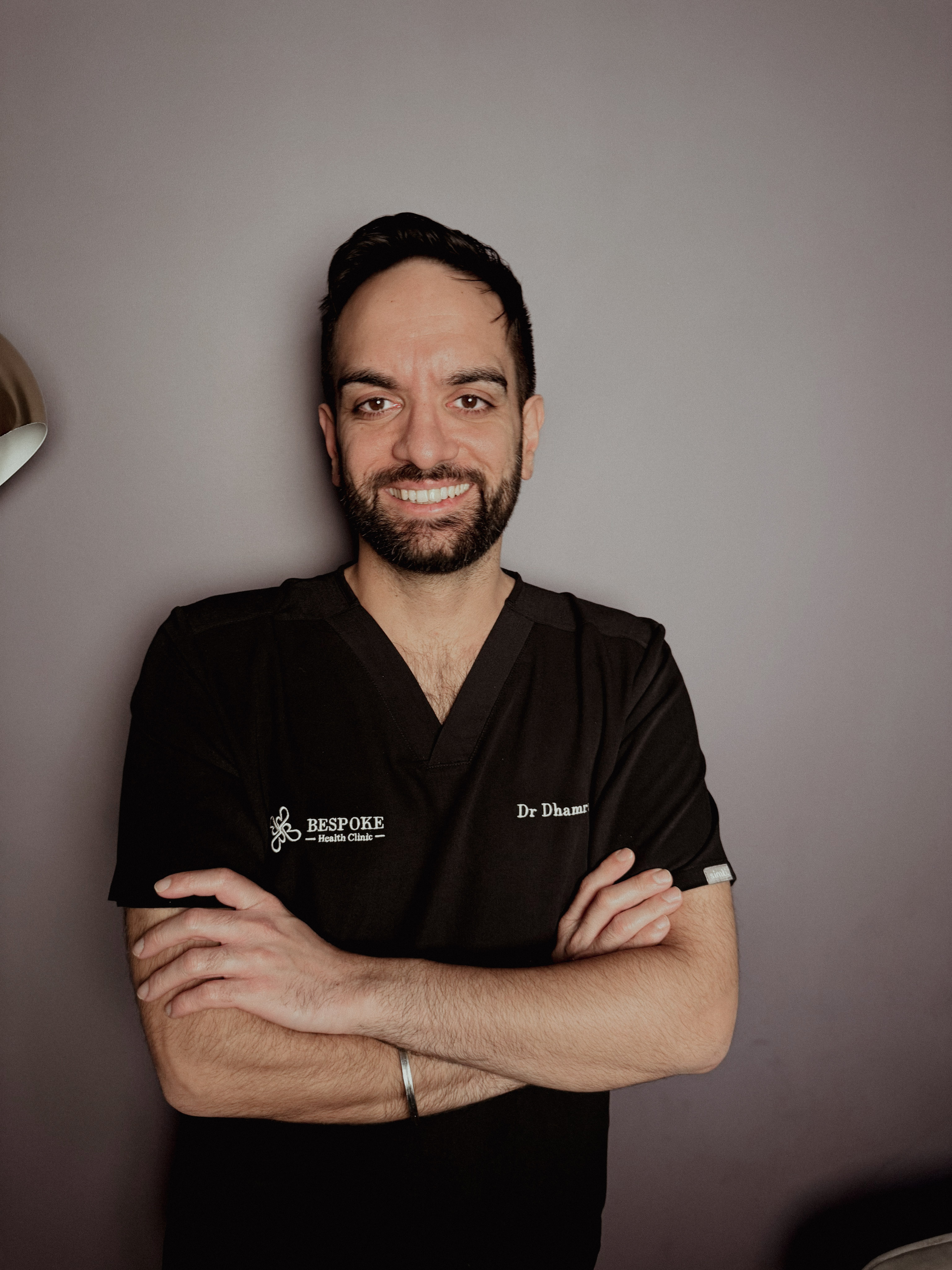
Dr Lakhvinder Dhamrait & Dr Ruchi Ahluwalia, GPs · bespokehealthclinic.com
DOES THIS SOUND LIKE YOU?
Most of us run on autopilot.
“I had the same health check at 45 as I did at 25.”
“I’ll sort my health out when things calm down.”
“I feel fine, so I assume I am.”
THE GOOD NEWS
The habits that matter most are simple, and it’s never too early or too late to start. In a study of over 23,000 adults, people with four healthy habits had a 78% lower risk of developing diabetes, heart attack, stroke or cancer over the following years.1
It’s never too early, or too late, to start.
Bespoke Health ClinicHealth by decade · 2
YOUR 20s AND 30s
Build the base.
20s: the habits you’ll keep
Regular sleep, daily movement, not smoking, and alcohol at or under 14 units a week, spread over several days.2
20s: cervical screening starts
Invitations begin at 25. It takes a few minutes and looks for changes before they become a problem.3
30s: muscle starts to slip
Without regular use, muscle mass and strength decline from around 30, by roughly 3–8% a decade.4
30s: start strength work
UK guidance is muscle-strengthening activity on at least two days a week, at every age.5
The habits you build in your 20s and 30s carry you through every decade after.
Bespoke Health ClinicHealth by decade · 3
YOUR 40s AND 50s
Check, don’t assume.
40s: perimenopause often begins
Broken sleep, brain fog, low mood and changing periods are common, and often put down to stress.6
40s: the NHS Health Check
Offered every five years from 40 to 74. It looks at your blood pressure, cholesterol and your risk of heart disease, stroke and diabetes.7
50s: bowel and breast screening
In England, bowel screening starts at 50 (every two years), and breast screening invitations start at 50 (every three years).3
50s: bones and vitamin D
From October to early March, consider 10 micrograms of vitamin D a day.8
Blood pressure is checked at every NHS Health Check.
Bespoke Health ClinicHealth by decade · 4
60s AND BEYOND, AND YOUR HERITAGE
Stay strong, stay steady.
2 days
of strength and balance a week
UK guidance for older adults, to help keep muscles strong and reduce the risk of falls.5 Men are also invited for an aortic (AAA) screen at 65.3
From 25
if you’re of South Asian heritage
Type 2 diabetes and heart disease risk can start earlier. NICE suggests checking your risk from 25 for people of South Asian, Chinese, African-Caribbean or Black African heritage.9
Bespoke Health ClinicHealth by decade · 5
EVERY DECADE
Four habits that matter most.
Don’t smoke
If you smoke, stopping is the biggest single change you can make, at any age. Your GP or pharmacy can help.
Move most days
Around 150 minutes of moderate activity a week, plus strength work twice a week.5
Eat mostly plants and whole foods
Plenty of vegetables, fruit and whole grains, and less processed food.1
Keep a healthy waist
A waist under half your height is a simple target that suits most adults.10
ONE QUESTION FOR YOUR NEXT CHECK
“What do my numbers mean for my risk, not just whether they’re in range?”
Bespoke Health ClinicHealth by decade · 6
FROM YOUR DOCTORS
“We read every result ourselves, and we explain it in plain English.”
Dr Ruchi Ahluwalia and Dr Lakhvinder Dhamrait, NHS GP partners
WAYS WE CAN HELP
Choose what fits your life.
Cognitive Assessment Six areas of thinking tested online at home, a 30-minute GP video call and a written summary.
£199
Brain & Body Check A nurse visit at home, the Core Panel of 40+ blood markers and the Cognitive Assessment, with a 30-minute GP call.
£499
BEST FIT FOR THIS GUIDE Insights A 45-minute GP deep dive, the Signature Panel of 60+ markers, a health check, two glucose sensors and a written report and plan.
£1,499
Precision Everything in Insights, repeated at six months, with three glucose sensors and six GP video calls to support the changes you make.
£3,996
Not sure which? Book a free 15-minute call with Dr Ahluwalia. Tailored programmes are available by application.
Bespoke Health ClinicHealth by decade · 7
Where are you, in your decade?
Insights looks at your bloods, your lifestyle and your family history together, so you know exactly what to focus on now, and what can wait.
4. Volpi E, et al. Muscle tissue changes with aging. Curr Opin Clin Nutr Metab Care 2004;7:405–10. doi:10.1097/01.mco.0000134362.76653.b2
5. UK Chief Medical Officers’ Physical Activity Guidelines. 2019. gov.uk
6. NHS. Menopause. nhs.uk/conditions/menopause
7. NHS. NHS Health Check. nhs.uk/tests-and-treatments/nhs-health-check
8. NHS. Vitamin D. nhs.uk/conditions/vitamins-and-minerals/vitamin-d
9. NICE. Type 2 diabetes: prevention in people at high risk (PH38). nice.org.uk/guidance/ph38
10. NICE. Overweight and obesity management (NG246): waist-to-height ratio. nice.org.uk/guidance/ng246
General information, not personal medical advice. If you are worried about a symptom, speak to your GP; in an emergency call 999. Bespoke Health Clinic is registered with the Care Quality Commission. Reviewed November 2026.